
To build housing, you need land. So you might think that rising land values are a cause of higher housing prices, in the same way that more expensive construction labor and materials drive up home prices. This is true in some contexts, but not in others. Land values can be a cause of housing prices, but housing prices can also be a cause of land values.
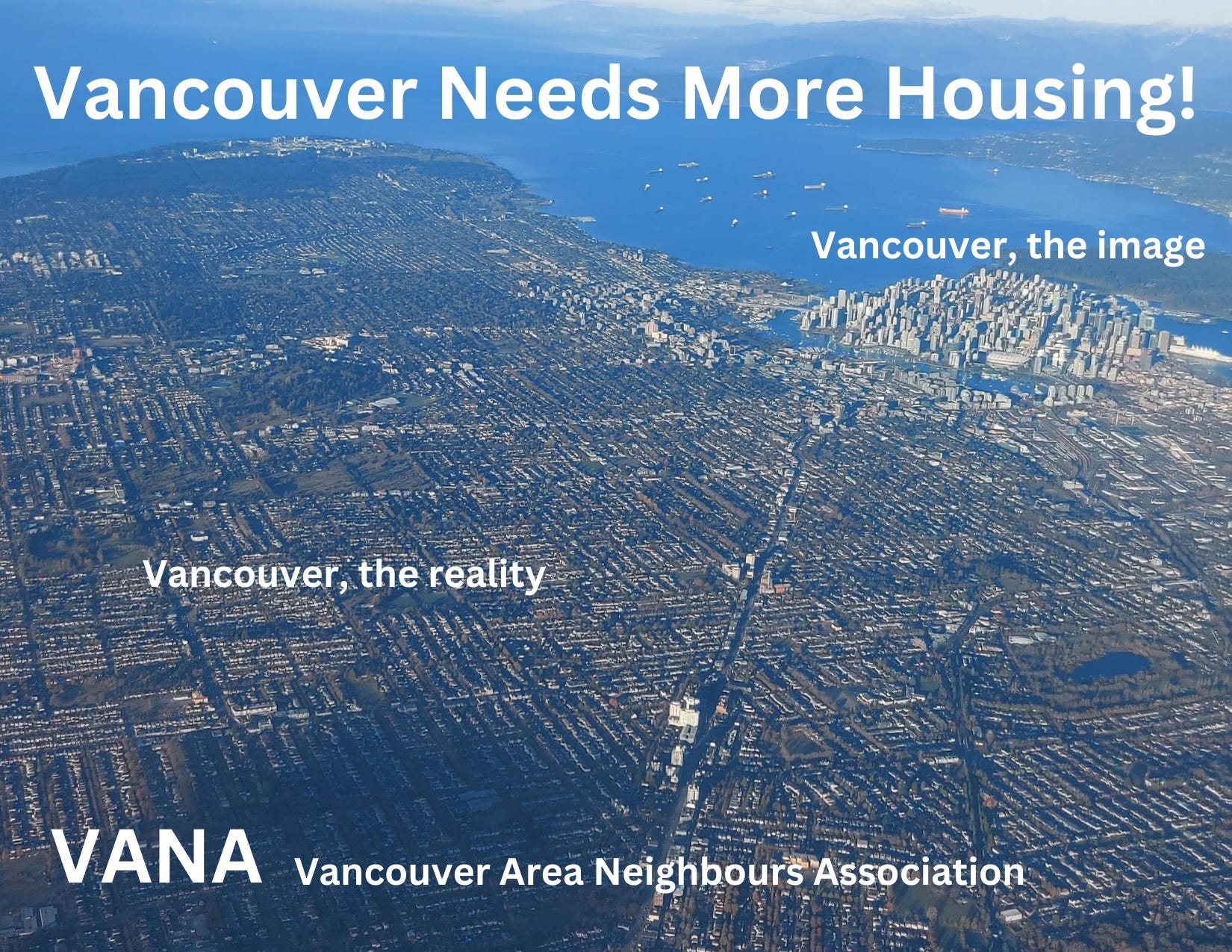
Consider a city of detached houses, like Vancouver.1 If you’re a developer trying to build apartments, you need to buy an existing house and redevelop it. But the average price of a house has risen from $400,000 in 2000 to over $3,000,000 today, reflecting a massive increase in demand from wealthy buyers to live in Vancouver. This translates to a large increase in assessed land values. So demand for detached houses sets a floor on land costs, since you need to outbid a house builder to acquire land.
For example, suppose a house builder is willing to pay $2M for a teardown bungalow, on which they can build a house that sells for $3M.2 Then as an apartment developer, you need to offer at least $2M to buy land. And when demand for houses goes up, house prices increase, so house builders will bid even more for teardowns. If house prices hit $3.5M, you now have to pay $2.5M for land, so your apartment project won’t pencil until rents go up.
In this scenario, higher land values represent higher input costs that drive up the price of new apartments. Land behaves like any other construction material, where higher input costs mean higher output prices.
But there’s an important case where this doesn’t hold: when the city upzones to allow higher-density housing. If we change the zoning from detached housing to allow apartment buildings, we create valuable development rights that developers will pay a premium for.
For example, take the bungalow above. When zoned for a single house, a builder was willing to offer $2M. Since apartments are not allowed, the apartment developer bids nothing. But if we upzone for 12-unit apartments, the developer is now an active bidder. Say the apartment building is worth $12M, and demolition and construction costs are $9M. Then the developer can pay $3M for land; assuming developers are competitive, this is also the parcel’s market price.
So upzoning increases the land value from $2M to $3M. But this is not an increase in input costs for building apartments. Initially, the apartment building wasn’t even allowed, meaning the land cost was infinite. Bringing that cost down to $3M is a definite improvement. Rather, the increased land value reflects the increase in total housing value, since a six-storey apartment building has more homes than a detached house.3
From this angle, high land values—when caused by upzoning—are a sign of success, because land is being employed for its most valuable use.4 When land is expensive, you should economize on it, by densifying and using less land per home. Restrictive zoning lowers land values by preventing developers from buying land and using it to build apartments. Low land values driven by constrained housing supply are a policy failure.
It is true that allowing apartment developers to bid on the land increases land costs for house builders. But this is a good thing. When zoning blocks apartments, it makes land artificially cheap by taking developers out of the market. This is a regressive subsidy from apartment renters to house buyers. If people want to live in detached houses, they should pay the market price.
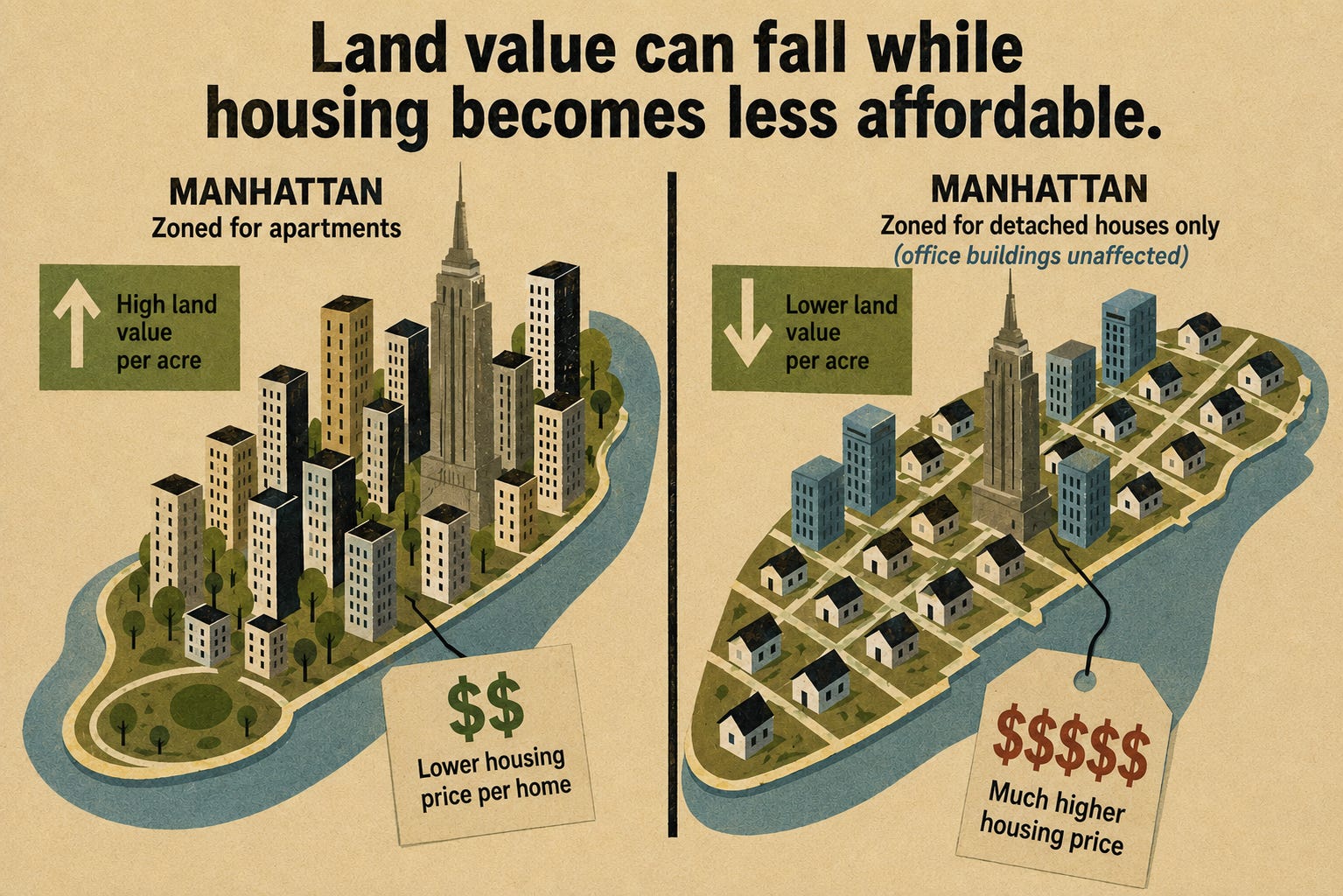
Ultimately, high land values are caused by high housing demand. Demand for detached houses pushes up the floor on land prices. And demand for apartments leads to higher land values when we upzone to allow them. But if demand is the root cause, then “lowering land values” is not a solution.5 We care about lowering housing prices, and the way to do that is by allowing more density to reduce land cost per home and increase housing supply; land prices are just a symptom. Manhattan would have much lower land values if it was zoned for detached houses, but also much higher housing prices.6
It is still mostly houses:
So construction costs are $1M.
More formally, land values push up apartment costs when a competing use sets the opportunity cost. For example, houses are the competing use for apartments, so an apartment developer has to outbid a house builder. Then higher house prices push up the landowner’s reservation price that the developer has to match. But when apartments are the highest-value use, then upzoning to allow apartments leads to higher land values, but not higher land costs.
And high land values can be captured for the public using land value taxes. Hence, we want high pre-tax land values and low after-tax land values.
Trivially, we can lower land prices by banning valuable land uses. If we want to reduce land costs for apartments, we can tax mansions.
This assumes that demand to live in Manhattan is unchanged, as the jobs remain in the office buildings.