
In 2011, the Vancouver Symphony Orchestra got a new music school—and a housing developer paid for it. How? The city let the developer build a larger apartment building in exchange for putting a music school in the lower floors. This is an example of value capture, where the city trades additional development rights for public amenities.
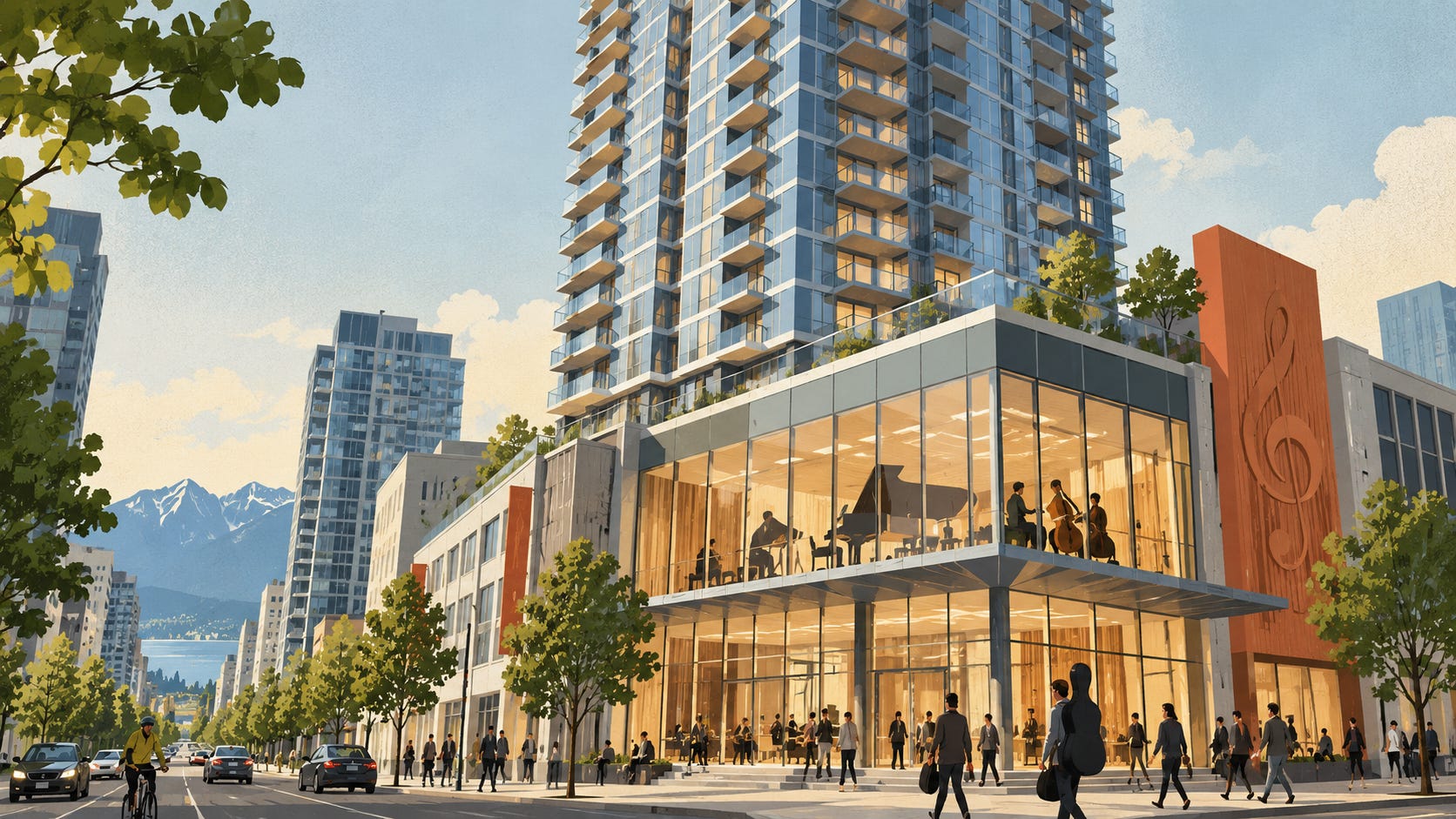
Arrangements like that are a win-win: we add new housing supply, and provide funding for amenities like parks, community centers, and social housing. So why aren’t we doing it everywhere?
In Vancouver, planners have taken a reluctant approach to value capture, limiting how much value is created, and hence how much can be directed toward public goods. That reluctance shows up in both the policies themselves and the language that’s used to defend them, and it raises a troubling question: does the city see new housing as a benefit, or as a harm to neighborhood character?
First, it’s important to understand how value capture works. Imagine you’re a Vancouver landowner. You could sell your property to a homebuyer for $2 million. But if the city upzoned your land to allow an apartment building, a developer would offer you $3 million. That extra million represents the value of the new land use, and it’s known as “land value uplift.”
The $1 million of new land value is a surplus that can be captured for public benefit, either by taxing the developer or requiring an in-kind contribution, as with the orchestra’s music school. When properly calibrated to keep the development feasible, value capture just means the developer pays the money—that uplift value—to the government instead of to the landowner. In effect, it’s a tax on a windfall gain.
That’s the source of the win-win, and to make the most of it the city ought to be deliberately creating land value by upzoning, and then capturing much of that value to fund public amenities. But in practice, city planners treat land value uplift as a problem, and use value capture as a way to prevent it.
An example: in 2023, the city legalized multiplexes, with fourplexes allowed on standard lots and sixplexes on larger lots. The city’s report on the change noted that fourplexes would not raise land values. But sixplexes, it said, “could impact land values significantly unless a [fee to capture that value] is required.”
Notice the odd phrasing. Why does the city say that sixplexes could raise land values “unless” it captures value? This gets things exactly backwards. Higher land values should be celebrated, because they mean we’re creating value that we can capture for the public. Land uplift is the source of the new value, but the city seems to care primarily about preventing it—and value capture, in its view, becomes just a means to that end.
The city’s streamlining rental policy is another example. That 2021 initiative allowed four- to six-storey rental apartments in some areas. According to the city’s report, six-storey buildings could raise land values, but the policy “would mitigate” this issue by requiring developers to offer some units at below-market rents, “thus absorbing any increases in land value.” Compare that to a positive framing: apartment buildings create value that we can capture to fund below-market rentals! Where does the city’s pessimistic attitude come from?
This timid, glass-half-empty way of thinking shows up again in the design of the city’s value capture policy. Planners allowed fourplexes to be only slightly larger than a detached house with a laneway home. If you built a fourplex, you were allowed just an extra 600 square feet in total, spread out over four homes. Is it any wonder such a stingy allowance didn’t raise land values? If Vancouver was seriously aiming to create value, it would have allowed sixplexes on every lot, with an extra 2,600 square feet of living space.
The streamlining rental policy allowed four-storey apartments on side streets near main roads, but this, too, didn’t create any value to capture. If building to six storeys did enable value capture, why didn’t planners extend that to side streets, as well?
It should be clear by now that when the primary goal is to create and capture value, rather than limiting land value uplift, we would propose more housing than planners allow. But so far I’ve been assuming that housing is a good thing. Can we make sense of the city’s policy by flipping that assumption on its head?
If we instead treat higher-density housing as a harm that ruins the neighborhood character, then value capture stops being win-win. Now there’s a win-lose tradeoff: capturing value for the public is good, but more housing is bad.
Looking at it this way helps explain the city’s lack of enthusiasm for value capture. When small fourplexes do not raise land values, it’s a relief, because that means they won’t transform the neighborhood. Similarly, we don’t want six-storey apartments blocking any views, even if they would bring in more funding for parks.
Why don’t city planners just say that? They could say that their priority is to preserve neighborhoods as they are, even if that means building fewer new homes. They could say that homeowner opposition to new density is a political fact that they have to respect. All that’s required is honesty about the choices being made, and city policy would be stronger for it.
Because voters deserve to know the values driving our housing policy. How much housing have we sacrificed, and how many music schools, parks, and other public amenities have we left on the table to maintain the character of low-density neighborhoods?