
Upzoning reduces housing prices by increasing the supply of high-density land and allowing developers to build more homes on the same parcel, which shifts the supply curve for housing. With lower housing prices, developers bid less for pre-existing high-density land; this reduces high-density land prices.
So to evaluate whether upzoning works, we first check whether increased housing supply results in lower home prices. As a second step, we can check whether existing high-density land becomes cheaper. This gives us a simple empirical test using land prices: take the set of high-density land that existed before upzoning, and track its price over time. However, no one has done this (yet).
For example, Auckland had 389 parcels zoned for terraced housing and apartments (THA) whose zoning status was unchanged by the 2016 upzoning.1 The THA zoning category increased in size to 13,341 parcels, as lower-density zones were upzoned to THA. Intuitively, the land price of the initial 389 THA parcels will fall, at least relative to single-family land, as competition from the thousands of new THA parcels leads to expectations of lower apartment prices and hence lower residual land values. So we can see whether upzoning worked by testing if increasing the supply of high-density land made it cheaper.2
São Paulo also upzoned in 2016, changing the allowed density on a block-by-block basis. On average, the built area ratio (BAR)3 increased by 35%, with about half of blocks being upzoned. We can use this to test whether upzoning reduced the price of existing higher-density land at a fine-grained level. For example, if upzoning increases the size of the BAR=4.0 category, then we expect apartment prices to fall and the price of the initial BAR=4.0 land to decrease. For categories that decreased in size, we might expect land prices to increase, for example, as detached houses become scarcer and more expensive, leading to higher residual land values.4 Here’s a hypothetical graph:
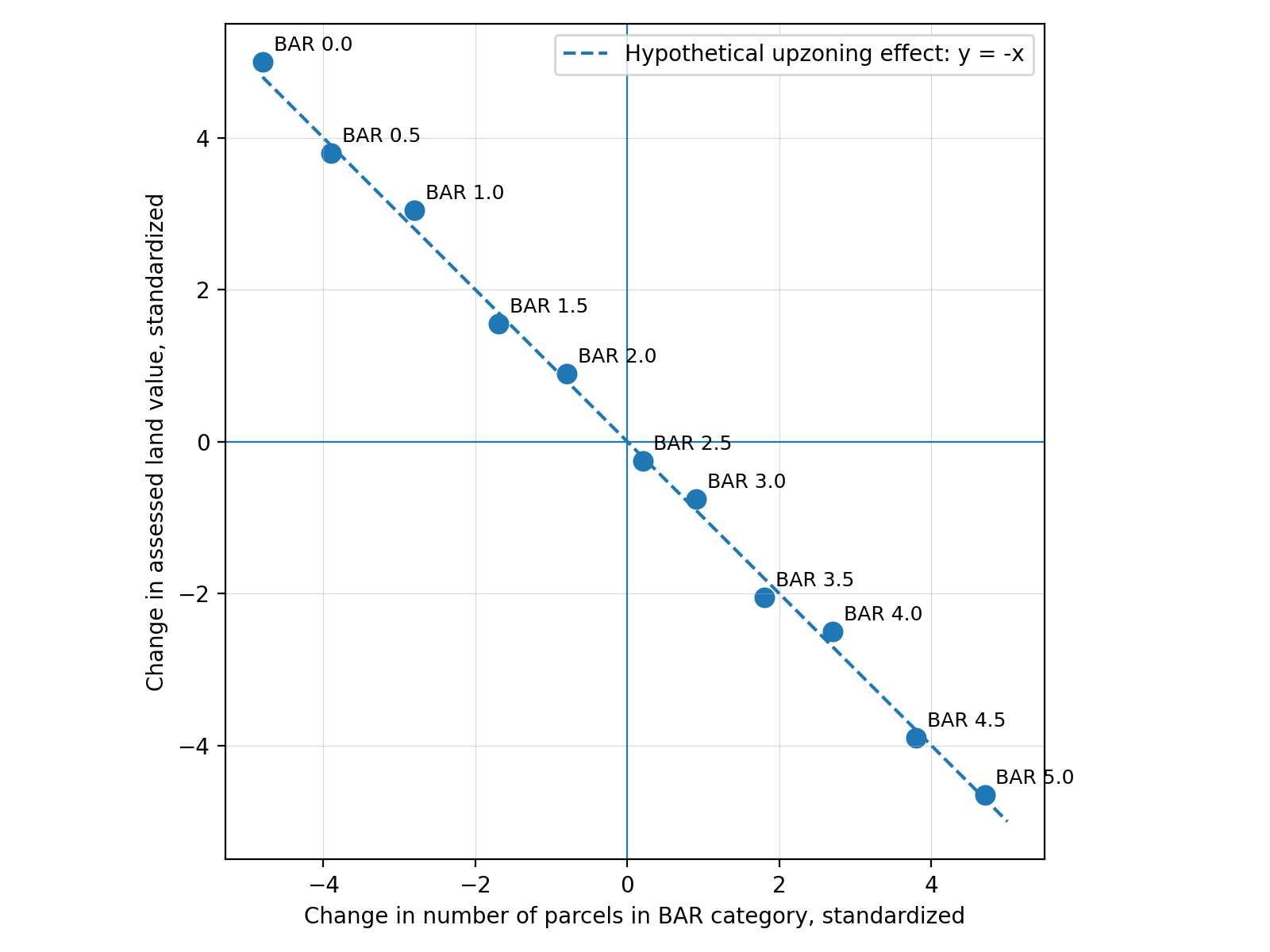
If you have access to data on land prices or assessed land values in Auckland or São Paulo, please reach out! Existing research has not looked at this question, and it seems straightforward to answer. Showing that upzoning reduces high-density land prices would give us empirical evidence for upzoning in addition to the main evidence on housing supply and prices.
There were initially 1880 THA parcels; 389 remained THA and 1491 parcels were downzoned. See Table 2 in Cheung, Monkkonen, and Yiu (2024).
Similarly, there were 3461 Mixed Housing Suburban (two storeys, three dwellings) parcels and 4880 Mixed Housing Urban (three storeys, three dwellings) parcels with unchanged zoning status. Since upzoning increased the size of the MHS and MHU zoning categories, we predict that the land price of the initial parcels decreased.
The ratio of a building’s total floor area to the land area. At BAR=1, a 1-story building could cover the entire lot, or a 2-story building could cover half of the lot.
The effect could be positive or negative. If high-density housing is a substitute for low-density housing, then increased supply of the former would decrease the price of the latter, which would translate to lower low-density land prices.
Lower housing prices drive lower land prices. Housing prices are determined by income distribution and housing availability, and land prices are determined by housing prices minus construction and maintenance costs.
Upzoning reduces land prices by increasing housing supply, dropping housing prices, and thus reducing the income stream of the property, so that a constant minimum return on investment of the property allows a lower purchase price.
“Since upzoning increased the size of the MHS and MHU zoning categories, we predict that the land price of the initial parcels decreased.” I’m interested in this research. My non-economic observations in Auckland indicate that both the land price of MHS has risen as it has become a more desirable zone and the MHU has become more valuable due to the higher densities enabled. It is not until after redevelopment that the land value per unit decreases. I hope I am understanding you correctly - that you are not concerned with the number of units on the land, just the undeveloped land value. Correct me if I’m wrong.
As an aside, I believe the number of MHS sites has decreased as many MHS have been upzoned to MHU.
I am a planner working in Auckland would be happy to discuss our situation here.